
Leading Through Tension: Why the Best Answers Rarely Live in “Either–Or”
A reflection on polarities, discriminating views, and the art of living with tension instead of fighting it

There are moments in leadership that feel like a bone you simply cannot stop chewing on. Centralization or decentralization? Control or trust? Stability or change? Focus on results or on relationships? You turn the question over and over, searching for the right answer – and do not find it. Or you find it, implement it, and three years later you are back at the very same point, only with reversed signs.
That is not a sign of bad leadership. It is a sign that you are trying to solve a problem that is not a problem at all.
The wrong tool for the wrong task
We are trained problem solvers. At school, university, and throughout our careers we learn: identify the problem, analyze the causes, find the best solution, implement it. This works beautifully for real problems. Which software should we buy? How should we design the onboarding process? Who takes on which task?
And then there is the other category. Questions that cannot be solved – not because we have not thought hard enough, but because they are structurally unsolvable. Barry Johnson, an American organizational consultant and author of the influential book “Polarity Management: Identifying and Managing Unsolvable Problems” (1992), calls this category polarities – and he draws a crucial distinction.
„A problem can have a right – or even the best – solution. A polarity, however, is an ongoing, unsolvable dilemma that contains seemingly opposing ideas.“
A polarity is not a flaw in the system. It is the system.
Polarities are pairs of opposites that depend on each other, like inhaling and exhaling. You cannot inhale forever. You cannot exhale forever. Both poles are necessary, both are legitimate, and neither can “win” in the long run. Leaders who miss this treat polarities like problems and end up trapped in a pendulum swing that burns energy and brings little real progress.
The pendulum and its standstill
The Center for Creative Leadership describes this phenomenon with a clarity that hurts, precisely because it feels so familiar. An organization grows and grows – until the infrastructure is bloated, costs explode, and inefficiencies spread. The pendulum swings back: cut, consolidate, streamline. Until the organization is so lean that innovation and growth no longer have a chance. Then the pendulum swings again.
Each new leader “solves” the problem left by their predecessor and, in doing so, creates the next one. Leadership consultant Larry Clark describes exactly this pattern on the Harvard Business Publishing blog: a wave of centralization brings consistency but loses touch with local markets. The next wave of decentralization restores closeness but sacrifices scalability. And so it goes on, ad infinitum.
The tragedy is this: everyone involved acts rationally. Everyone sees a real problem. Everyone finds a real solution. And yet the system keeps turning in circles.
The error does not lie in the thinking – it lies in the category into which we sort the issue in the first place.
What makes a polarity – and how to recognize one
Johnson describes polarities using a few simple characteristics. A situation is a polarity (and not a solvable problem) when:
It is ongoing – it keeps reappearing, no matter how often you have “solved” it.
Both poles have real advantages – there are strong reasons for centralization and strong reasons for decentralization.
Both poles have real downsides - when pursued in isolation or taken to an extreme.
The poles depend on each other – each needs the other in order to be complete.
Typical polarities in leadership and organizations include:
Stability ↔ Change
Control ↔ Autonomy
Task focus ↔ Relationship focus
Short-term thinking ↔ Long-term thinking
Individual performance ↔ Team performance
Structure ↔ Flexibility
None of these tensions can be resolved once and for all. Yet all of them can be navigated.
Polarity mapping: Working with tension instead of against it
Johnson’s central tool is the Polarity Map – a simple four-quadrant matrix that helps you see a polarity in its entirety.
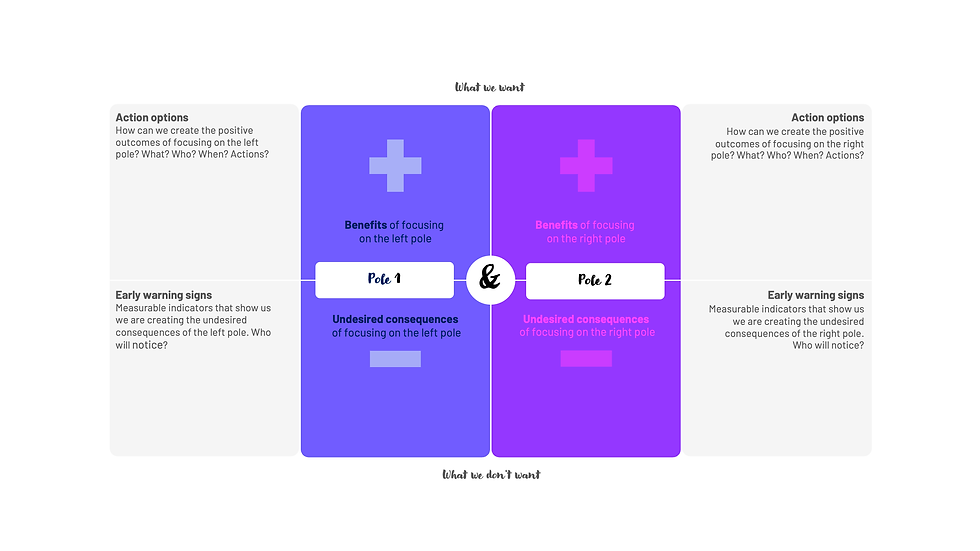
The crucial step is not to pick a pole, but to fill all four quadrants honestly. What do we gain when we emphasize Pole A? What do we lose when we overdo Pole A?
What do we gain when we shift toward Pole B? What do we lose when we overdo Pole B?
This exercise sounds simple. It is not. It demands something that is rare in many organizational cultures: the honest recognition that the “other side” is right as well. That the colleague advocating for more control has reasons just as legitimate as the colleague fighting for more autonomy. That both poles hold necessary truths.
The goal is no longer to win the conflict, but to navigate it together: When do we need more of Pole A? When do we need to lean into Pole B? Which early warning signs tell us that we are drifting into the downsides of a pole?
Johnson’s own research and independent analyses point in the same direction: organizations that actively manage core polarities – consciously leveraging both poles instead of swinging wildly between them – achieve measurably better business outcomes than those that do not. Polarity Partners, the institute Johnson founded, sums up the findings succinctly:
„Leaders, teams, and organizations that leverage polarities are more successful than those that do not.“
This pattern has been empirically confirmed also in specific sectors such as healthcare.
When the mind slices the world apart
Up to this point, one might think: this is a clever management tool. Useful, pragmatic, good.
But there is a deeper layer. One that does not come from management discourse at all, but from a centuries‑old observation of the human mind.
Thich Nhat Hanh, the Vietnamese Zen monk and peace activist, describes a phenomenon he calls “discriminating views” – our deeply rooted human tendency to slice reality into categories: good/bad, right/wrong, strong/weak, winner/loser.
This tendency is not malicious. It is evolutionarily smart – it helps us judge, decide, and act quickly. But it comes with a price tag: it blinds us to the interdependence of things. We see opposites where there are continuums. We see opponents where there are complements. We see problems where there are, in truth, fields of tension.
In Buddhist thinking – especially in the teaching of “Interbeing”, a term shaped by Thich Nhat Hanh – the fundamental assumption is different: nothing exists in isolation. Everything carries its apparent opposite within itself. The flower contains the cloud (without rain, no growth). Strength contains vulnerability (without vulnerability, no genuine connection). Courage always carries fear (without fear, courage is not needed).
„In the heart of a flower you can see the cloud, the sunshine, the earth, and the gardener. Nothing exists by itself.“ Thich Nhat Hanh
When we lead and act from discriminating views – and most of the time we do – we experience polarities as a threat. As contradictions that must be resolved. As signs of weakness or indecision. And we reach for the only tool we know: decision. Either–or. Clear. Unambiguous. Done.
Yet this clarity is often an illusion of control – purchased at the cost of complexity, nuance, and ultimately: reality.
Leading beyond discriminating views
What is the alternative? Not indecisiveness. Not the famous “both–and” as an excuse for avoiding tough calls. Rather something that could be called mature tolerance for ambiguity: the capacity to endure tension without rushing to dissolve it.
In their 2022 book “Both/And Thinking”, Marianne Lewis and Wendy Smith describe three key movements:
Surfacing tensions: Actively look for the polarities at work in your system instead of ignoring them or treating them as disturbances. This also means deliberately inviting people with opposing perspectives.
Embracing tensions: Restrain the impulse to force a decision just to enjoy the feeling of closure. Good leadership sometimes means staying in the tension until a deeper understanding emerges.
Processing tensions: Continuously scan how the poles relate to one another – both differentiating and integrating. What separates the poles? And what unites them at a higher level?
This may sound theoretical, but it is first and foremost a matter of attitude. And stance shows itself in small moments. How do I respond when someone in a meeting presents a perspective that contradicts my own? Do I pause, or do I fire back immediately? Can I say: “That is true. And at the same time, the other thing is also true”?
What this means in practice
Leadership – whether in a formal role, as self‑leadership, or in taking responsibility in the moment – becomes, in a complex world, ever more an art of navigation than a science of solving. A few concrete impulses:
Recognize the category before you act.
Ask yourself: is this a problem (with a single best solution), or is it a polarity (that wants to be managed)? A simple test: if the “problem” keeps coming back even though you have already “solved” it, you are probably dealing with a polarity.
Create a Polarity Map.
Take twenty minutes. Write down the two poles. Fill in all four fields – the upsides and downsides of both sides. Then invite someone who naturally champions the other pole. Not to argue, but to see the fuller picture.
Observe your “discriminating views”.
When do you judge quickly? When do you sort people or ideas into “right” and “wrong”? This is not a reproach; it is an invitation to curiosity. What might you be overlooking when you sort that fast?
Practice staying with the tension.
Not every tension must – or can – be resolved immediately. Sometimes the wisest leadership move is: not yet deciding. Holding the space. Inviting more information. Using the tension as a signal rather than as a problem.
Look for the higher level.
Polarities often cannot be resolved on their own level – but they can be reframed on a higher one. What is the shared purpose both poles serve? What are control and autonomy both trying to achieve? Often it is trust. Or effectiveness. Or dignity. Once you find this shared core, the quality of the conversation shifts, and new options come into view.
A closing thought

There is a beautiful metaphor from Zen that I return to again and again: the image of bamboo in a storm. The bamboo does not break. Not because it is rigid – it survives because it bends. It has roots and flexibility. Stability and movement. Both. At the same time.
Leadership in a complex world demands exactly that: the capacity to bend without losing your roots. To hold tension without breaking under it. And the wisdom to discern the difference between what must be solved – and what wants, quite simply, to be lived.
That is not a mark of weak leadership. It may be the most demanding and wisest expression of leadership strength there is.
Sources & further reading:
Center for Creative Leadership: Are You Facing a Problem or a Polarity? — ccl.org
Barry Johnson: Polarity Management: Identifying and Managing Unsolvable Problems, HRD Press, 1992 — summarised via Pears Foundation Summary
Harvard Business Organization / Larry Clark: Navigating Complexity: Managing Polarities — harvardbusiness.org; as well as Marianne Lewis & Wendy Smith: Both/And Thinking, HBR Press, 2022
Thich Nhat Hanh: Interbeing: Fourteen Guidelines for Engaged Buddhism, Parallax Press; as well as The Heart of the Buddha's Teaching, Broadway Books, 1998
Polarity Partnerships (Barry Johnson): The Power of PACT – polaritypartnerships.com
Wesorick, B. & Shaha, S.: Polarity Management: The Key Challenge for Integrated Health Systems, in: Journal of Nursing Administration, 1999 – via ResearchGate


Comments